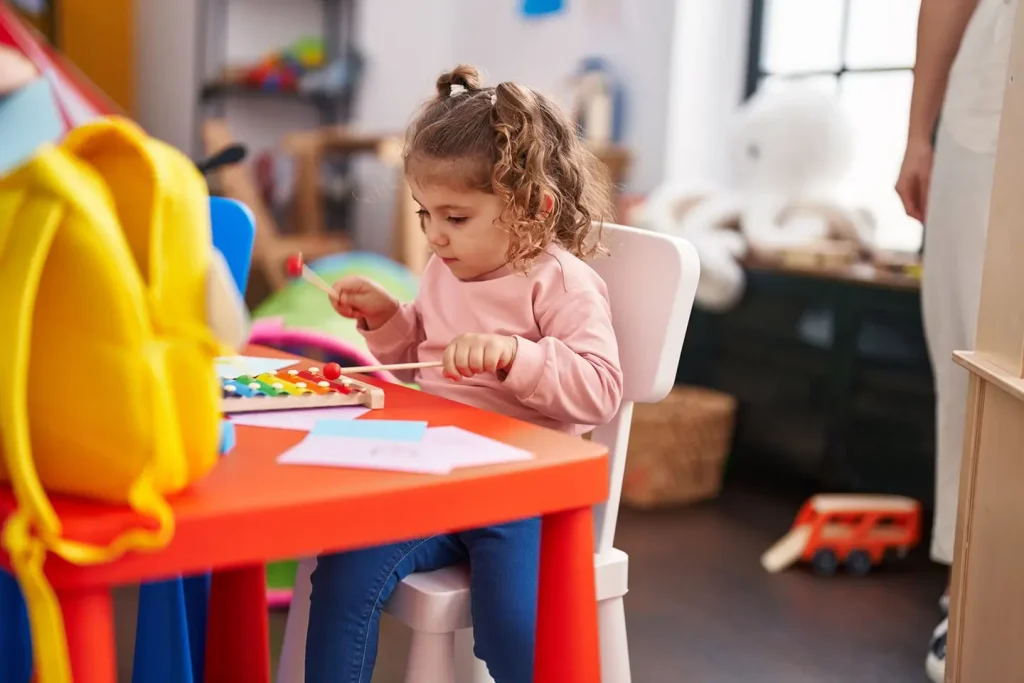
Rhythm is everywhere. Whether it’s musical rhythm or the rhythm of life, everything is rhythm. And without this fundamental integration, the entire structure of the individual can become disorganized. This isn’t about frequency or the repetition of activities over time, but rather about pulse, lived dynamics, this inner measure that allows each person to feel aligned with what they are doing. In our society, which values speed, we too often forget that everyone has their own tempo for understanding, integrating, and retaining information. Teachers also experience this in their classrooms: without a suitable pace, children are less focused and less attentive. What if the true driving force of learning wasn’t just memory or willpower, but rhythm itself? I explain everything in this article about the link between rhythm and learning !
Rhythm is an essential key to learning
Learning isn’t just about memory or intelligence. It’s also about rhythm! This pulse, often ignored by traditional educational methods, is nevertheless one of the fundamental drivers for anchoring concepts learned in class. As neurobiologist Lucy Vincent reminds us in her book ” Make Your Brain Dance,” our thinking is rooted in the moving body: indeed, coordinating a gesture, integrating a sequence, or even following a line of text relies on the same neural circuits we need for thinking or planning. Rhythm isn’t just clapping along to music. It’s also the internal structure that allows each of us to orient ourselves in time, manage our emotions, and organize our thoughts. It awakens the so-called “conscious” neural circuits, those that process information slowly, but over the long term. This is the complete opposite of the intuitive, reflexive, and rapid approach encouraged by our instant gratification society!
Research conducted by INSERM supports this finding: a rhythmic music training program offered to dyslexic children led to significant progress in reading. Children who participated in a rhythmic music workshop improved their ability to discriminate sounds, read unfamiliar words, and even exceeded the diagnostic criteria for dyslexia in 60% of cases. Music theory without rhythm did not have this effect. Why? Because rhythm regulates the brain’s oscillatory activity, which allows us to organize sounds, hear the differences between a full stop (PA) and a half stop (BA), and stabilize our gaze. In short, rhythm structures our mental space-time !
In the MULTI’MOUV method that I have been developing for several years, rhythm is at the heart of everything. Each physical exercise is based on the pulse: natural, musical, or provided by a metronome. It is not simply a motor activation, but a deep sensory anchoring that connects movement to self-awareness, space, and time.
The benefits of rhythm for autistic children
What if rhythm were a path to serenity? This is what a growing number of studies on neurodevelopmental disorders, particularly autism, suggest. The body, emotions, and relationships with others: these are all sensitive, sometimes painful, areas in the daily life of an autistic person.
A recent British experiment, conducted as part of the Clem Burke Drumming Project, tested the effects of drumming on autistic teenagers. Two sessions per week for two months. The results? Reduced hyperactivity, improved inhibitory control, better emotional regulation, and a decrease in repetitive behaviors. Furthermore, MRI scans showed changes in brain areas related to attention and planning.
In other words, playing the drums isn’t just about creating sound; it’s also about creating a connection between body and mind. Structuring a movement, repeating it, feeling it— this establishes a safe and engaging framework. And rhythm provides that framework.
Moreover, this learning rhythm is an integral part of the activities I offer in the MULTI’MOUV® method: juggling on the floor, manipulating sandbags while following a metronome, synchronizing one’s movements with others, etc. All of this creates stable reference points that promote body grounding, emotional management, and a sense of security.
I would like to draw your attention to an important point: working with rhythm and tempo is not reserved for autistic people. All individuals, regardless of their background or age, can benefit from adapted rhythmic work. Where rapid learning inevitably fails, rhythm opens another path. A pulse for attention. A pulse for emotions. A pulse for being present.
Rhythm and learning-learn at your own pace with MULTI’MOUV
Simply adding rhythm to a session isn’t enough to guarantee benefits. The movement must be experienced, conscious, and adapted to the individual. This is the core philosophy of the MULTI’MOUV® method: to offer a clear educational framework that respects how the brain functions in every individual.
The program is based on three pillars:
- A three-step protocol for entering the exercise (verbalization, movement, equipment);
- Physical exercises set to a rhythmic background;
- Mobilizing speech to promote integration.
Each child enters the exercise through a multisensory gateway: auditory, visual, tactile, etc. Rhythm then acts as a guiding thread that connects these different channels. The metronome, the muffled sounds of the bags, the pulse of the movement: everything is designed to activate slower neural circuits, those of concentration, planning, and memorization.
And the results speak for themselves: improved focus, reduced stress, a more stable posture, and smoother reading . Ultimately, learning at one’s own pace isn’t about slowing down. It’s about respecting the time each individual needs to develop. It’s about providing a structured rhythm without rushing. So, are you ready to tailor your teaching to the right approach?
The link between rhythm and learning is far from trivial. It permeates the entire educational process, from gesture to language, from attention to memory, from emotional regulation to self-expression. By integrating rhythm into teaching practices, we not only diversify approaches but also fundamentally transform the way we teach and learn. It becomes clear that rhythm acts as a structuring foundation. Today, the question is no longer whether rhythm has a place in learning, but rather how to implement it, bring it to life, and adapt it to each individual.